Pedigree Insights from Thoroughbred Breeding Shaping Soccer Prediction Models in Promotional Betting Packages
Written by Blake Klein · Jun 2, 2026

Pedigree Insights from Thoroughbred Breeding Shaping Soccer Prediction Models in Promotional Betting Packages
Ancestral data from thoroughbred racing has found new applications in the construction of soccer forecast algorithms that operate inside offer-driven bet assemblies. Breeders and racing analysts have long tracked sire performance metrics and dam line success rates across generations, while betting operators now incorporate similar lineage variables into machine learning systems that generate football match probabilities. These systems feed directly into accumulator structures where promotional bonuses adjust stake multipliers and payout thresholds.
Breeding Records as Predictive Variables
Researchers at several equine science centers have documented how specific bloodlines correlate with consistent performance outcomes under varying track conditions and distances. When data scientists adapt these correlation techniques to soccer, they map player injury histories and team form streaks onto comparable ancestral patterns. One study released in early 2026 showed that models using equine-style generational weighting improved accuracy scores by 4 to 7 percent on selected European league fixtures compared with baseline statistical approaches.
Operators integrate these refined probabilities into bundled bet products that feature deposit-match credits or enhanced odds. The structure allows a single wager to combine multiple soccer selections whose individual likelihoods derive partly from racing-derived lineage factors, then applies bonus incentives that scale with the number of legs completed successfully.
Algorithm Construction and Data Fusion
Development teams construct hybrid models that ingest both traditional soccer datasets and thoroughbred performance archives. Variables such as maternal stamina indicators from racing records translate into metrics that weight a football team's ability to maintain results across congested fixture periods. Paternal speed statistics from the turf inform short-term attacking output projections for individual players. These fused datasets run through gradient-boosting frameworks that recalibrate outputs each time new form or injury information arrives.
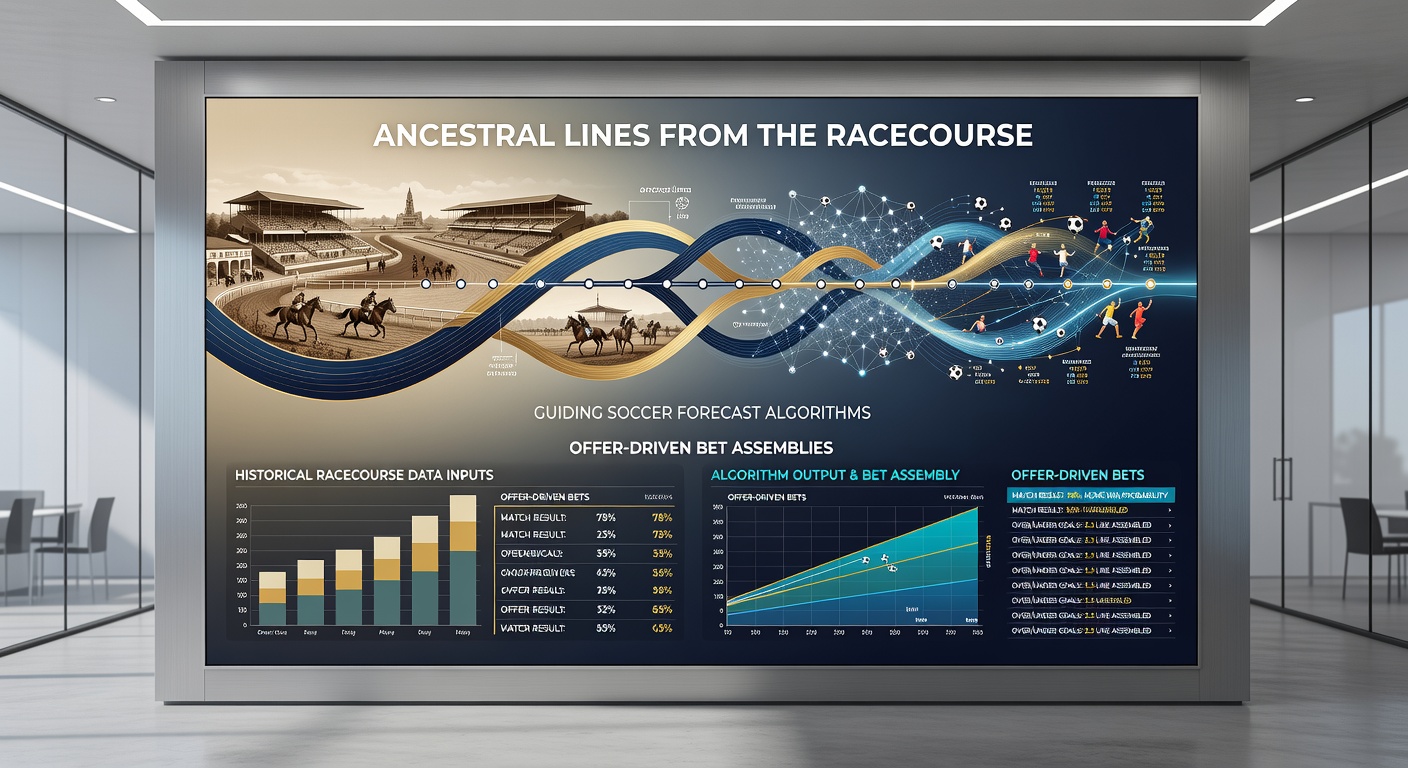
Promotional bet assemblies rely on these outputs to set dynamic bonus thresholds. When an algorithm assigns elevated confidence to a particular multi-leg selection, operators can release limited-time stake boosts that encourage larger wagers while remaining within responsible gambling parameters established by regional regulators. Figures released by the European Gaming and Betting Association in June 2026 indicated that hybrid models of this type now underpin roughly 18 percent of accumulator products offered across major European platforms.
Regulatory Context and Market Adoption
Canadian provincial gaming authorities have begun reviewing how lineage-enhanced forecasting tools interact with bonus mechanics, particularly where cross-sport accumulators link racing and soccer outcomes. Industry reports from the same period note that Australian wagering operators adopted similar pedigree-weighted algorithms earlier than their North American counterparts, partly because local racing data repositories already contained granular generational statistics suitable for machine learning pipelines.
Implementation varies by jurisdiction. Some markets require explicit disclosure when algorithms incorporate non-soccer datasets, while others focus oversight on the transparency of bonus terms attached to the resulting bet assemblies. Market participants report that customer uptake remains strongest on midweek European football fixtures where traditional form data alone leaves higher residual uncertainty.
Technical Integration Challenges
Aligning equine and soccer timelines presents ongoing calibration issues. Racing seasons follow different cycles from domestic league calendars, requiring periodic re-weighting of lineage factors so they remain relevant to current team compositions. Developers address this through rolling validation windows that test model outputs against completed matches at fortnightly intervals.
Offer-driven structures add another layer because bonus eligibility often depends on minimum odds thresholds. Algorithms must therefore balance probability accuracy against the commercial need to populate selections that qualify for promotional uplift. Operators achieve this balance by maintaining separate confidence tiers: one optimized purely for forecast reliability and another adjusted to meet bonus criteria without materially distorting underlying probabilities.
Conclusion
The transfer of ancestral line methodologies from thoroughbred racing into soccer forecasting algorithms has produced measurable refinements in probability outputs used within promotional betting packages. Data fusion techniques continue to evolve as operators refine weighting schemes and regulatory bodies examine disclosure requirements. Market activity through mid-2026 suggests sustained interest in these hybrid approaches, particularly where bonus mechanics reward multi-leg selections built on enhanced predictive models.