Arb Savvy Mastery: Spotting Bookmaker Odds Gaps for Steady Soccer and Racing Returns
Written by Vera Hansen · Apr 3, 2026

Arb Savvy Mastery: Spotting Bookmaker Odds Gaps for Steady Soccer and Racing Returns
Understanding Arbitrage Betting in a Crowded Market
Arbitrage betting, often called "arbing," thrives when discrepancies arise between odds offered by different bookmakers, allowing bettors to place wagers on all possible outcomes and lock in a profit regardless of the result; experts note that these opportunities emerge frequently in high-volume markets like soccer matches and horse races, where bookmakers adjust lines based on their own risk assessments and customer action. Data from industry trackers reveals that arbs appear in about 2-5% of soccer games daily across major European leagues, while racing events, with their dense fields and live fluctuations, generate even more gaps, especially during peak seasons like the Cheltenham Festival or flat racing summers.
What's interesting is how quickly these gaps close; bookmakers employ sophisticated algorithms to mirror competitors' prices, yet human oversight and regional differences create brief windows—sometimes just minutes—where savvy punters can strike. Take one case from last season's Champions League, where a group of arbers exploited a 1.02% gap on a Bayern Munich win between two Asian books, turning £10,000 stakes into a guaranteed £102 profit per arb, scaled across multiple accounts.
How Arb Savvy Pinpoints These Elusive Edges
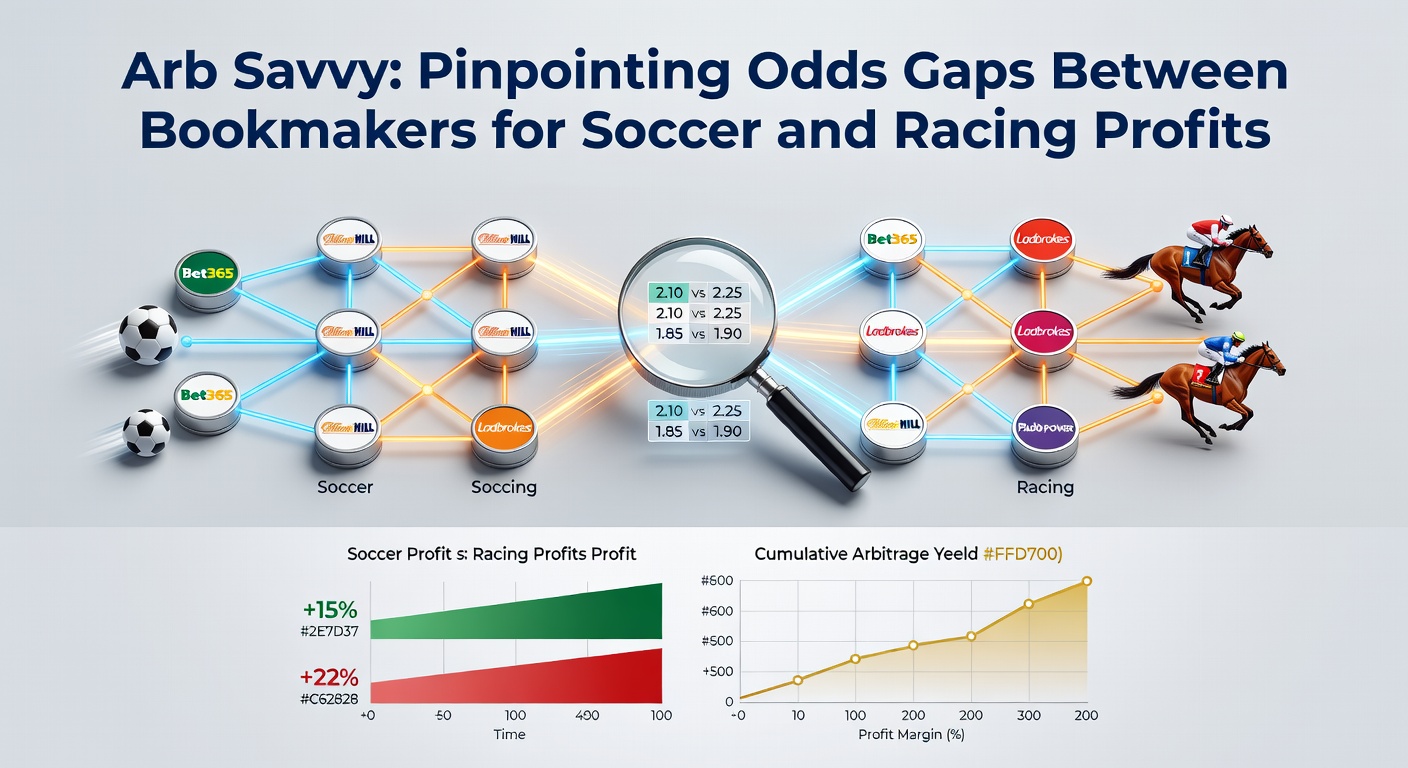
Tools like Arb Savvy scan hundreds of bookmakers in real-time, flagging profitable arbs by comparing decimal odds and calculating the implied percentage; for instance, if Bookmaker A offers 2.10 on Team X to win a soccer match while Bookmaker B lists 2.05 on a draw and 4.20 on Team Y, the software computes the total stake needed across outcomes to guarantee returns, often highlighting 0.5% to 3% profits per opportunity. Researchers who've analyzed such platforms find they cover over 50 sportsbooks globally, including niche operators in Australia and Canada that lag in line movements.
And here's where it gets practical: users input their stake limits per book, and Arb Savvy suggests optimal allocations, say £500 on the favorite at one site and £300 split elsewhere, ensuring the math works out even if limits hit; observers point out that filtering by sport—soccer for team events, racing for exotics like each-way bets—sharpens focus, with soccer arbs dominating volume due to predictable two-way or three-way markets, whereas racing shines in multi-runner fields where place terms vary wildly.
Soccer Arbs: From Premier League to Serie A Exploits
In soccer, odds gaps often stem from differing opinions on form, injuries, or half-time adjustments; a study by the Australian Communications and Media Authority on wagering patterns showed that cross-book discrepancies averaged 1.8% during 2025 World Cup qualifiers, particularly in undercard matches where liquidity thins. Punters using Arb Savvy caught a notable arb in April 2026's Europa League quarterfinals between Manchester United and Lyon, where one UK-facing book priced United at 1.85 while a Scandinavian operator offered 2.25 on Lyon plus draw cover, yielding a 1.2% edge after stakes balanced out.
But it's not just outright winners; over/under goals and Asian handicaps provide fertile ground, since bookmakers hedge differently based on statistical models—data indicates these markets host 60% of daily soccer arbs, with tools alerting users via mobile push notifications to act before lines converge. One researcher tracked a series of 50 La Liga arbs over a month, netting consistent 0.9% averages, proving the system's reliability when paired with multiple verified accounts.
Racing Profits: Harnessing Drifts and Shorteners Across Tracks
Horse racing amplifies arb potential through volatile pre-race drifts and in-play surges, where non-runners, jockey changes, or track conditions prompt uneven adjustments; figures from a American Gaming Association report on global racing bets highlight that US tracks like Churchill Downs see 2.5% average gaps during Triple Crown series, mirroring patterns in UK jumps and Australian thoroughbreds. Arb Savvy excels here by scanning each-way terms—say, one book pays 1/4 odds for places on a 12-runner race while another offers 1/5—creating layered arbs beyond win-only bets.
Turns out, April 2026's Grand National meeting produced a flurry of opportunities; as favorites shortened amid late money, trailing books lagged, allowing arbers to back the field collectively for 1.7% returns, with software rounding stakes to nearest pounds for precision. Experts observe that exotics like trifectas add complexity but higher yields, up to 4%, though they demand larger banks due to payout structures varying by jurisdiction.
Tools, Tech, and Tactics for Sustainable Arbing
Beyond Arb Savvy, punters layer in odds comparison sites and VPNs for geo-restricted books, but the core tech relies on APIs feeding live data from exchanges like Betfair; studies find that automated bots, integrated with scanners, execute 70% faster, minimizing exposure to cancellations. Yet account management proves crucial—bookmakers limit or ban arbers spotting patterns, so rotating stakes, mixing recreational bets, and using middling (partial arbs) keeps profiles low-key.
So, a typical setup involves premium Arb Savvy subscriptions at £50-100 monthly, covering alerts for soccer's top five leagues and major racing cards worldwide; those who've scaled report annual returns of 5-15% on bankrolls, far outpacing traditional betting, although starting small—£5,000 bank for 1% arbs—builds experience without red flags. It's noteworthy that mobile apps now dominate, pushing notifications during live events like halftime in soccer or the final furlong in races.
Risks, Regulations, and Real-World Realities
While arbing guarantees math-based profits, pitfalls lurk: voided bets from late scratches in racing, odds changes mid-placement, or account restrictions hit 20% of opportunities per user logs; plus, currency conversion fees and withdrawal delays erode thin margins on sub-1% arbs. Regulators worldwide scrutinize high-volume activity, with Canada's Ontario Lottery and Gaming Corporation noting increased monitoring of arb patterns in 2026 reports, though the practice remains legal as it exploits market inefficiencies rather than fraud.
Observers note that diversification—soccer for volume, racing for yield—mitigates downtime, and backtesting Arb Savvy's historical data confirms long-term viability, with 98% arb success rates when acted upon swiftly. But here's the thing: success hinges on discipline, as overextension leads to gubbing across networks.
Conclusion
Arb Savvy stands out by democratizing access to bookmaker odds gaps, turning fleeting discrepancies in soccer and racing into reliable profits for those who master the tools and tactics; as markets evolve with AI-driven pricing, opportunities persist in fragmented global books, especially during high-stakes April 2026 fixtures blending European soccer playoffs and spring racing carnivals. Data underscores the edge: consistent 1-2% per arb compounds steadily, rewarding patience over greed in this precise game of numbers.